
Physical Activity for Cancer Patients
Supervised exercise during cancer treatment and after remission, built around you
Physical activity is a well-studied supportive therapy in oncology. At Active Health Clinic in Achrafieh, Beirut, our physiotherapists and adapted physical activity experts design and supervise personalized exercise programs for people living with cancer, during cancer treatment and after remission.
Exercise is generally safe for people with cancer, it helps against fatigue and improves quality of life during treatment,[7] and after treatment it is associated with a lower risk of recurrence and death.[1][2][3] It complements, and never replaces, the treatment prescribed by your oncology team.
During cancer treatment
During chemotherapy, radiotherapy, or hormone therapy, the goal is to protect your strength, energy, and independence while your body is under strain, and to make treatment easier to live with. What the research shows:
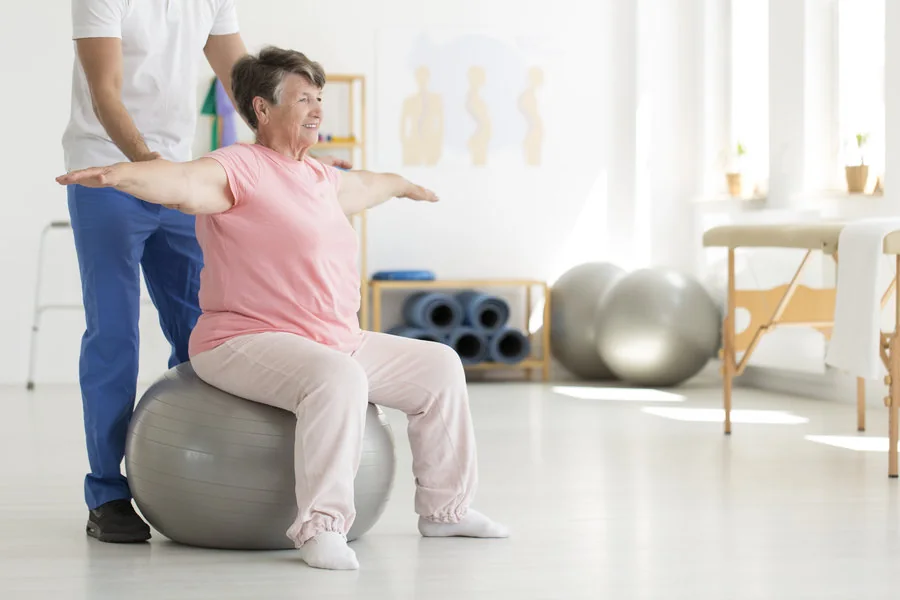
Exercise adapted to your treatment
- Individualized to your treatment: your program is adapted to your type of cancer and to the treatment you are receiving, and adjusted as it changes.
- Scaled to your day: lighter and shorter when you are tired, progressive when you feel strong.
- A balanced program: gentle aerobic activity, resistance work, balance, and mobility, with attention to fatigue, joint stiffness, and swelling risk after lymph node surgery.
After cancer treatment and remission
When treatment ends, many people are left deconditioned, tired, and unsure how hard they can push. Regular physical activity is now one of the most useful things you can do for your long-term health.
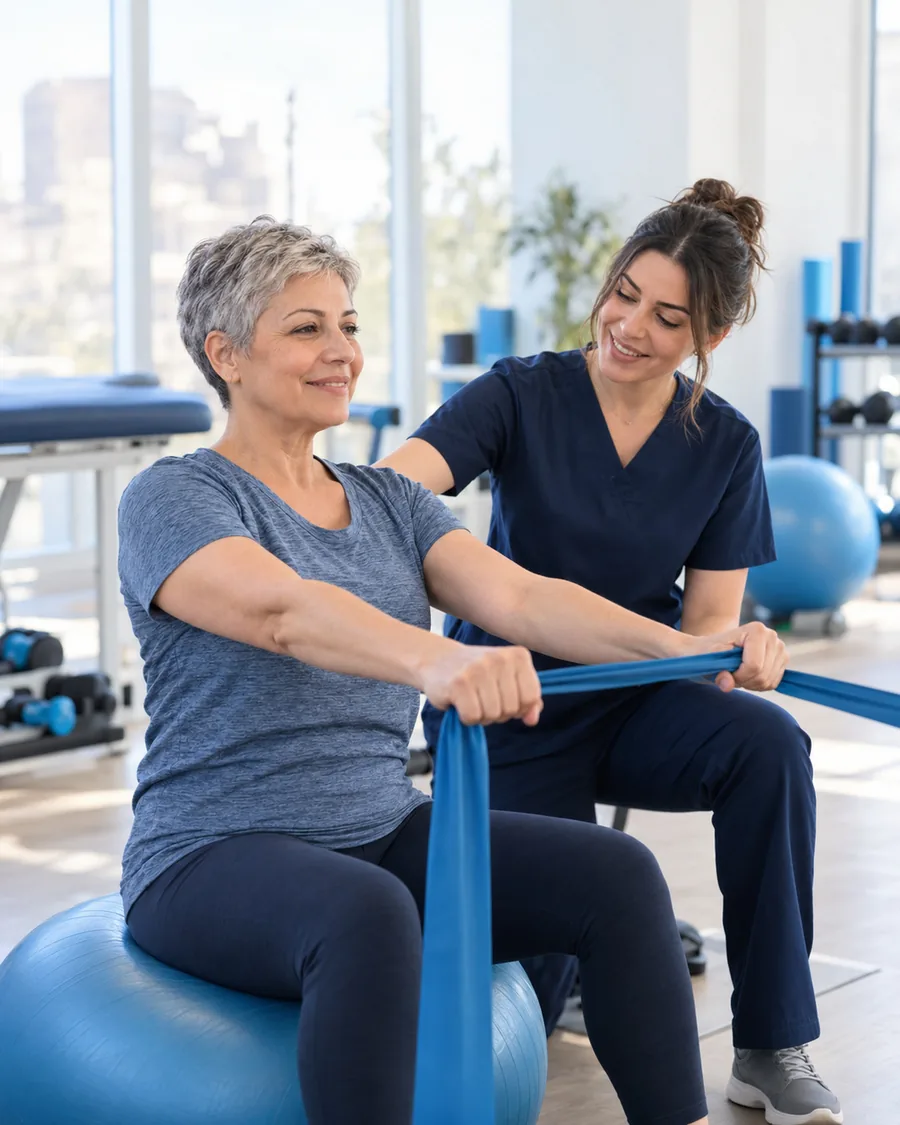
Rebuilding your strength for the long term
- A full physiotherapy assessment: strength, mobility, balance, fatigue, scars, and the late effects of your treatment.
- A progressive personalized program, built with our adapted physical activity expert toward 150 to 300 minutes of moderate activity per week plus strength training on at least 2 days.[8] We start from where you are.
- Guided sessions: exercise at the clinic with our team, adjusted as your strength and confidence return.
- Joined-up support: our nutritionist and psychotherapy team are available when food, weight, or mood are part of your recovery.
Your team and how it works
Your program is built and followed by our physiotherapists, Tracy Makhoul DPT, Charbel Nakhle MSc, and Rolando Al Helou, together with Marc Berbary MSc, sports scientist specialized in adapted physical activity.
Safety first
For most people, exercise is safe and helpful before, during, and after treatment,[9] but you should always check with your health care team before starting or changing your activity. Some situations call for medical clearance and a modified plan, for example low blood counts, fever or infection, bone involvement, recent surgery, or severe fatigue. Your program is individualized and adapted to your treatment and condition, and adjusted as they change.
This page is for information and does not replace medical advice from your oncology team.
Frequently asked questions
Is it safe to exercise during chemotherapy or radiotherapy?
For most people, yes. International expert consensus concludes that exercise is generally safe for people with cancer, and the American Cancer Society states that physical activity is safe and helpful before, during, and after treatment for most people. Because every situation differs, we ask you to discuss your plan with your oncology team first, and your program is individualized and adapted to your treatment, symptoms, and energy.
Can exercise reduce the risk of cancer coming back?
Research points that way. In a randomized trial in colon cancer, a structured exercise program started after chemotherapy lowered the risk of recurrence, a new cancer, or death by 28%. For breast, colorectal, prostate, and lung cancer, people who were physically active after diagnosis had a lower risk of dying from their cancer in large observational studies. These are group results, not guarantees for any individual, and exercise never replaces the treatment prescribed by your oncology team.
How much activity should I aim for after treatment?
The American Cancer Society recommends working up to 150 to 300 minutes of moderate-intensity activity (or 75 to 150 minutes of vigorous activity) per week, plus muscle-strengthening exercise on at least 2 days per week. You do not start there: at a minimum the goal is to avoid inactivity, and our team builds up your program step by step from your current level.
I feel exhausted during treatment. Should I still exercise?
Often yes, in the right dose. Research shows that exercise reduces cancer-related fatigue, while drug treatments did not show a significant effect. Your program is individualized: sessions are adapted to your treatment and how you feel, lighter on hard days, and progress when you feel better.
Is strength training safe if I have lymphedema?
With slow, gradual progression, evidence says yes. In a randomized trial of women with breast-cancer-related lymphedema, weight lifting did not increase limb swelling, reduced flare-ups (14% versus 29%), and caused no serious related adverse events.
Who designs and supervises the programs at Active Health Clinic?
Programs are built and followed by our physiotherapists, Tracy Makhoul DPT, Charbel Nakhle MSc, and Rolando Al Helou, together with Marc Berbary MSc, sports scientist specialized in adapted physical activity. Our nutritionist and psychotherapy team are also available when it helps.
How do I start?
Book an initial assessment by phone (+961 1 336376), WhatsApp (+961 81 763210), or through the contact form. The clinic is on Independence Street, Malia Building, 4th Floor, Achrafieh, Beirut, open Monday to Friday, 9 am to 7 pm, and Saturday, 9 am to 12 pm.
Sources
- Courneya KS, Vardy JL, O'Callaghan CJ, et al. Structured exercise after adjuvant chemotherapy for colon cancer (CHALLENGE trial). N Engl J Med. 2025;393:13-25. doi:10.1056/NEJMoa2502760
- Lahart IM, Metsios GS, Nevill AM, Carmichael AR. Physical activity, risk of death and recurrence in breast cancer survivors: a systematic review and meta-analysis of epidemiological studies. Acta Oncol. 2015;54:635-654. doi:10.3109/0284186X.2014.998275
- Ungvari Z, Fekete M, Varga P, et al. Exercise and survival benefit in cancer patients: evidence from a comprehensive meta-analysis. GeroScience. 2025;47:5235-5255. doi:10.1007/s11357-025-01647-0
- Mustian KM, Alfano CM, Heckler C, et al. Comparison of pharmaceutical, psychological, and exercise treatments for cancer-related fatigue: a meta-analysis. JAMA Oncol. 2017;3:961-968. doi:10.1001/jamaoncol.2016.6914
- Irwin ML, Cartmel B, Gross CP, et al. Randomized exercise trial of aromatase inhibitor-induced arthralgia in breast cancer survivors. J Clin Oncol. 2015;33:1104-1111. doi:10.1200/JCO.2014.57.1547
- Schmitz KH, Ahmed RL, Troxel A, et al. Weight lifting in women with breast-cancer-related lymphedema. N Engl J Med. 2009;361:664-673. doi:10.1056/NEJMoa0810118
- Campbell KL, Winters-Stone KM, Wiskemann J, et al. Exercise guidelines for cancer survivors: consensus statement from the international multidisciplinary roundtable (American College of Sports Medicine). Med Sci Sports Exerc. 2019;51:2375-2390. doi:10.1249/MSS.0000000000002116
- Rock CL, Thomson CA, Sullivan KR, et al. American Cancer Society nutrition and physical activity guideline for cancer survivors. CA Cancer J Clin. 2022;72:230-262. doi:10.3322/caac.21719
- American Cancer Society. Physical activity when you have cancer. cancer.org. Patient information page, accessed October 2026. cancer.org