
Adapted Physical Activity in Beirut
Medically supervised exercise for chronic conditions, rehabilitation, and healthy aging
Adapted physical activity (APA) is structured exercise modified to your health condition, physical capacities, and medical history. At Active Health Clinic in Achrafieh, Beirut, APA programs are designed and supervised by a team of physiotherapists and a sports scientist, in coordination with the clinic's physicians, so that people living with a medical condition can train safely, rebuild capacity, and protect their long-term health.
Regular physical activity is one of the most powerful treatments in medicine. The World Health Organization recommends that adults accumulate 150 to 300 minutes of moderate aerobic activity per week plus muscle-strengthening work at least twice a week, and that adults living with chronic conditions stay as active as their abilities allow. The challenge is doing it safely. That is exactly what adapted physical activity is for.
Who is it for?
- People living with chronic conditions: back and neck pain, joint pain and arthritis, obesity, diabetes, fibromyalgia, and chronic pain in general.
- People recovering from injury or surgery: a supervised bridge between physiotherapy and full, independent activity.
- Older adults: progressive strength and balance work against sarcopenia, osteoporosis, and fall risk.
- Anyone told to "exercise more": who wants a safe, structured, professionally guided way to start.
How it works at the clinic
- 1. Clinical assessment: your medical history, current condition, strength, mobility, and balance are evaluated first. When relevant, our physicians or your treating doctor are involved.
- 2. Personalized program: the team builds an exercise plan around your condition and goals, with the right type, dose, and progression of exercise.
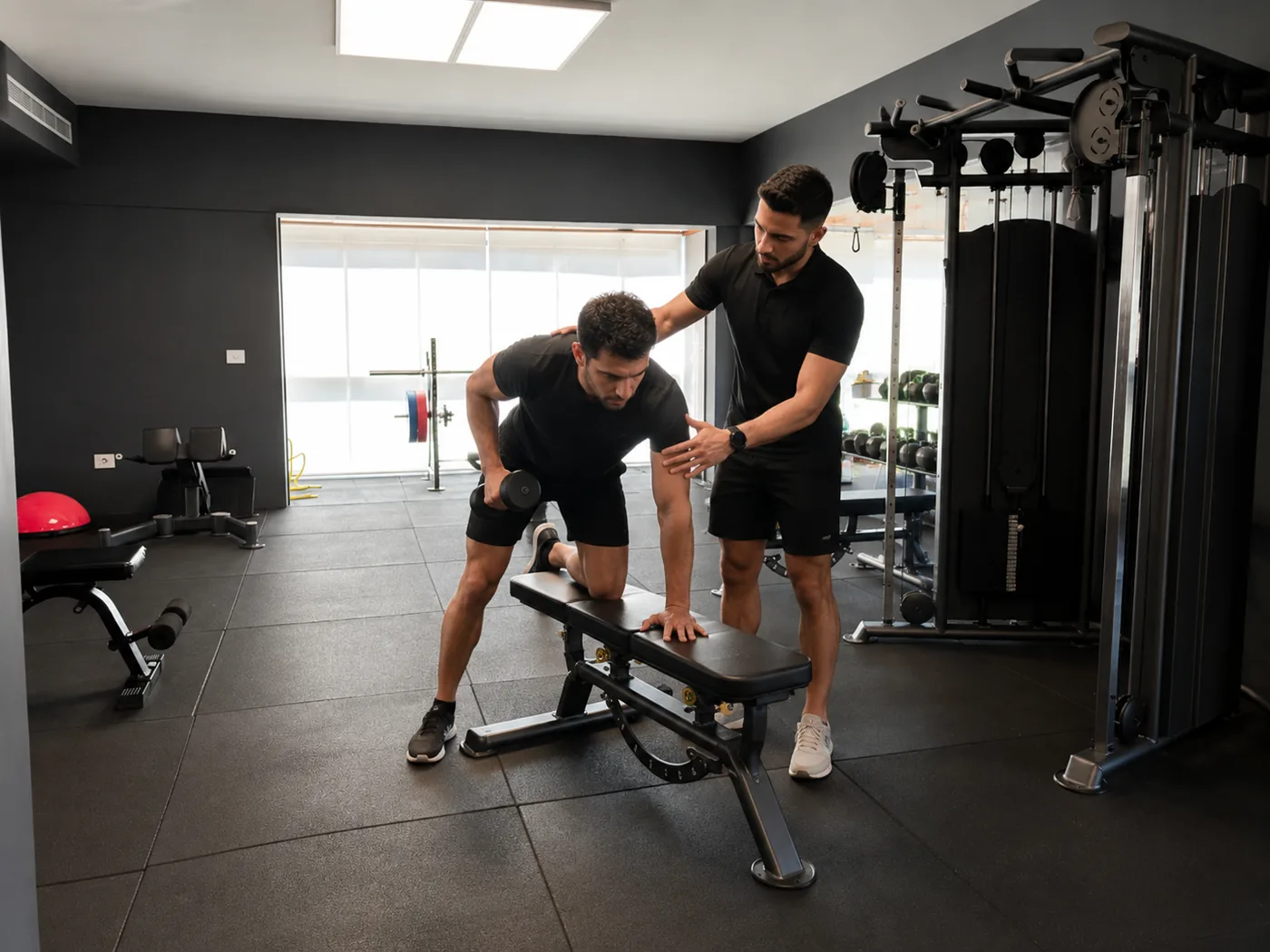
- 3. Supervised sessions: you train one-on-one in the clinic's private training room, guided and corrected at every step.
- 4. Progress reviews: your program is re-evaluated regularly and adjusted with the medical team as your capacity improves.
Condition-specific adapted programs
Sarcopenia: rebuilding muscle and strength
Sarcopenia is the progressive loss of muscle mass and strength that comes with age, and it accelerates when we stop challenging our muscles. It affects walking, stair climbing, balance, and independence. The most effective response is progressive resistance training: supervised strength work with loads that are adapted to your level and increased gradually. Our sarcopenia programs combine this structured strength training with guidance on protein intake and overall nutrition through our nutrition service, because muscle rebuilding depends on both training and diet.
Osteoporosis: training for stronger bones
Bones respond to loading. For people with osteoporosis or low bone density, appropriately dosed resistance and weight-bearing exercise can help maintain bone strength, while posture work and back-strengthening exercises protect the spine. Just as important, our programs train balance and body control to reduce the risk of falls, the main cause of fractures. Exercises are selected carefully for your fracture risk, and when relevant we coordinate with your physician or our family medicine service.
Balance and coordination training
Coordination, balance, and reaction speed can be trained at any age. Our programs use progressive proprioceptive and stability exercises to improve how your body senses and controls movement: standing balance, gait confidence, agility, and coordination between the upper and lower body. This work is valuable for older adults who want to prevent falls, for patients returning from injury, and for athletes who want sharper movement control, often in combination with physiotherapy.
Chronic conditions and special populations
Adapted physical activity is one of Marc Berbary's core specializations. Programs are adjusted for people living with chronic conditions such as chronic pain, obesity, or diabetes, and for anyone who has been told to "exercise more" but does not know where to start safely. Training intensity, exercise selection, and progression are all matched to your condition and reviewed regularly with the clinic's team.
Designed and supervised by clinicians
This is what separates adapted physical activity at Active Health from training in a gym. Your program is built and followed by health professionals working as one team: sports scientist Marc Berbary MSc, specialized in adapted physical activities, and physiotherapists Tracy Makhoul DPT and Charbel Nakhle MSc, with the clinic's family medicine and pain management physicians involved whenever your condition requires it. Nutrition support can be added when muscle rebuilding or weight management is part of the goal.
For structured, goal-oriented options, see our personal physical training service and the multidisciplinary treatment programs.
Frequently asked questions
What is adapted physical activity?
Adapted physical activity (APA) is structured exercise that is modified to a person's health condition, physical capacities, and medical history. Instead of a one-size-fits-all fitness plan, the type, intensity, and progression of exercise are prescribed and adjusted by health professionals, so people with chronic conditions, injuries, or age-related limitations can train safely and effectively.
Who is adapted physical activity for?
It is designed for people living with chronic conditions such as back pain, arthritis, obesity, diabetes, or fibromyalgia, people recovering after an injury or surgery, older adults facing muscle loss (sarcopenia) or osteoporosis, and anyone who has been advised to exercise but does not know how to start safely.
Is it safe to exercise with a chronic condition?
Yes, when exercise is properly adapted. International guidelines, including those of the World Health Organization, recommend that adults living with chronic conditions stay as physically active as their condition allows, because appropriate exercise improves pain, function, and quality of life. At Active Health Clinic every program starts with a clinical assessment, and exercises are selected and supervised by our physiotherapists and sports scientist.
Can sarcopenia be improved at my age?
Yes. Muscles respond to progressive resistance training at any age, including in the 70s and beyond. With supervised strength work and adequate protein intake, most people can rebuild measurable strength and improve daily function. The key is a program adapted to your starting level that progresses gradually.
Is strength training safe if I have osteoporosis?
With proper supervision, yes, and it is one of the most useful things you can do. Exercises are selected for your fracture risk, emphasizing safe resistance work, posture, and balance training to reduce fall risk. When relevant, we coordinate with your treating physician.
Who designs and supervises the programs at Active Health Clinic?
Programs are designed and supervised jointly by our team: sports scientist Marc Berbary MSc, physiotherapists Tracy Makhoul DPT and Charbel Nakhle MSc, in coordination with the clinic's physicians and the rest of the multidisciplinary team when a medical condition requires it.
How is this different from training in a gym?
In a gym, programs are built around fitness goals and assume a healthy body. In adapted physical activity, the starting point is your health: a clinical assessment of your condition, capacities, and history. Exercise selection, load, and progression are managed by health professionals, sessions take place in a private clinical setting, and your progress is reviewed with the medical team, not just a trainer.
How do I start, and do I need a medical referral?
No referral is needed. You can book an initial assessment directly by phone, WhatsApp, or the contact form. If you are already followed by a physician for a medical condition, we coordinate with them when relevant. The clinic is on Independence Street, Malia Building, 4th Floor, Achrafieh, Beirut, open Monday to Friday, 9 am to 7 pm, and Saturday, 9 am to 12 pm.